Obsession (2026): My Thoughts & Full Review

For the last couple of weeks, all I’ve seen over my Substack is one word: Obsession.
Ironically, people were all obsessed with the film, Obsession. I’m sure I’m not the first person to crack that joke, but you can’t beat a classic.
And I’m fairly sure that Obsession itself will become a classic in its own right one day. Because it was phenomenal in story, in themes, in fear. As horror films go, wow, this one certainly gives it its all.
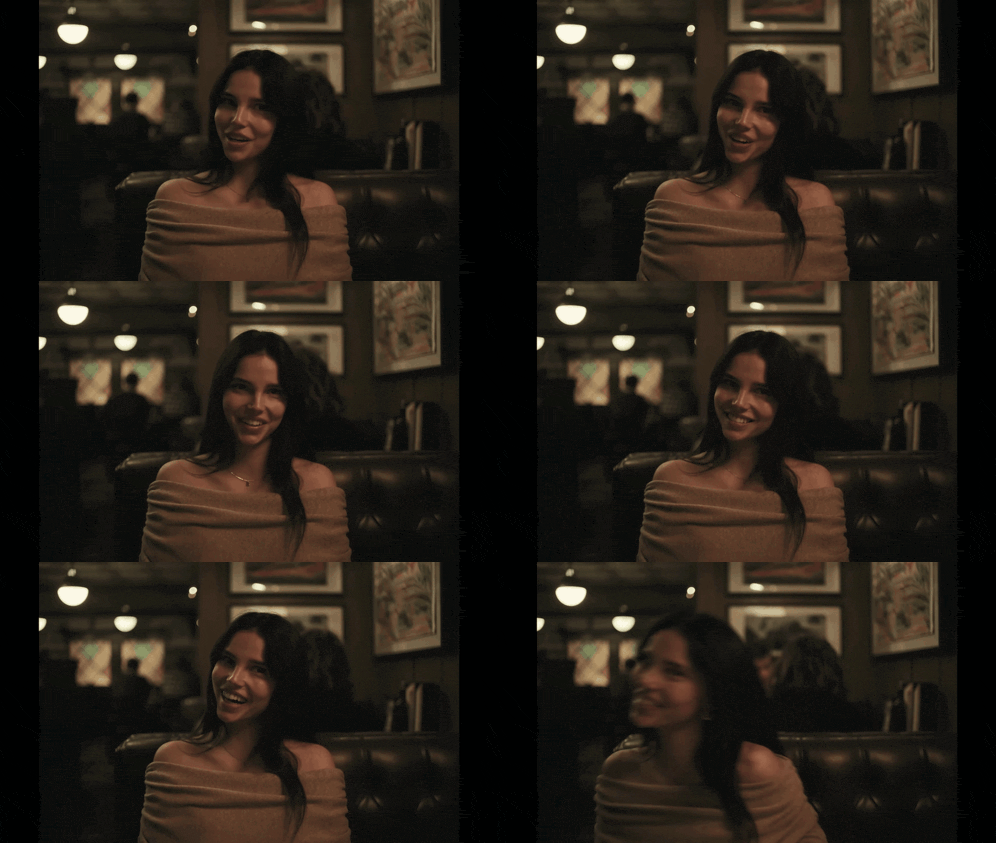
Written and directed by Curry Barker, Obsession premiered during the Midnight Madness block at the 2025 Toronto International Film Festival on 5th September 2025, before releasing in UK cinemas on 15th May 2026.
The film stars Michael Johnston as Bear, who is deeply, overwhelmingly in love with his long-time friend and co-worker, Nikki (Inde Navarrette), and has been for a long time. Unable to tell her how he really feels, he resorts to breaking the mysterious ‘One Wish Willow’ (seen to be some sort of collectible-toy-like object he buys from a store that sells crystals and suchlike) and uses his one wish to have Nikki love him more than anything else in the world. His wish is granted, but, as the tagline of the film states, you should: “be careful who you wish for...”
Please note: Beyond this section, there are spoilers for the film, so if you haven’t see it, please save the post and come back to it after you have!
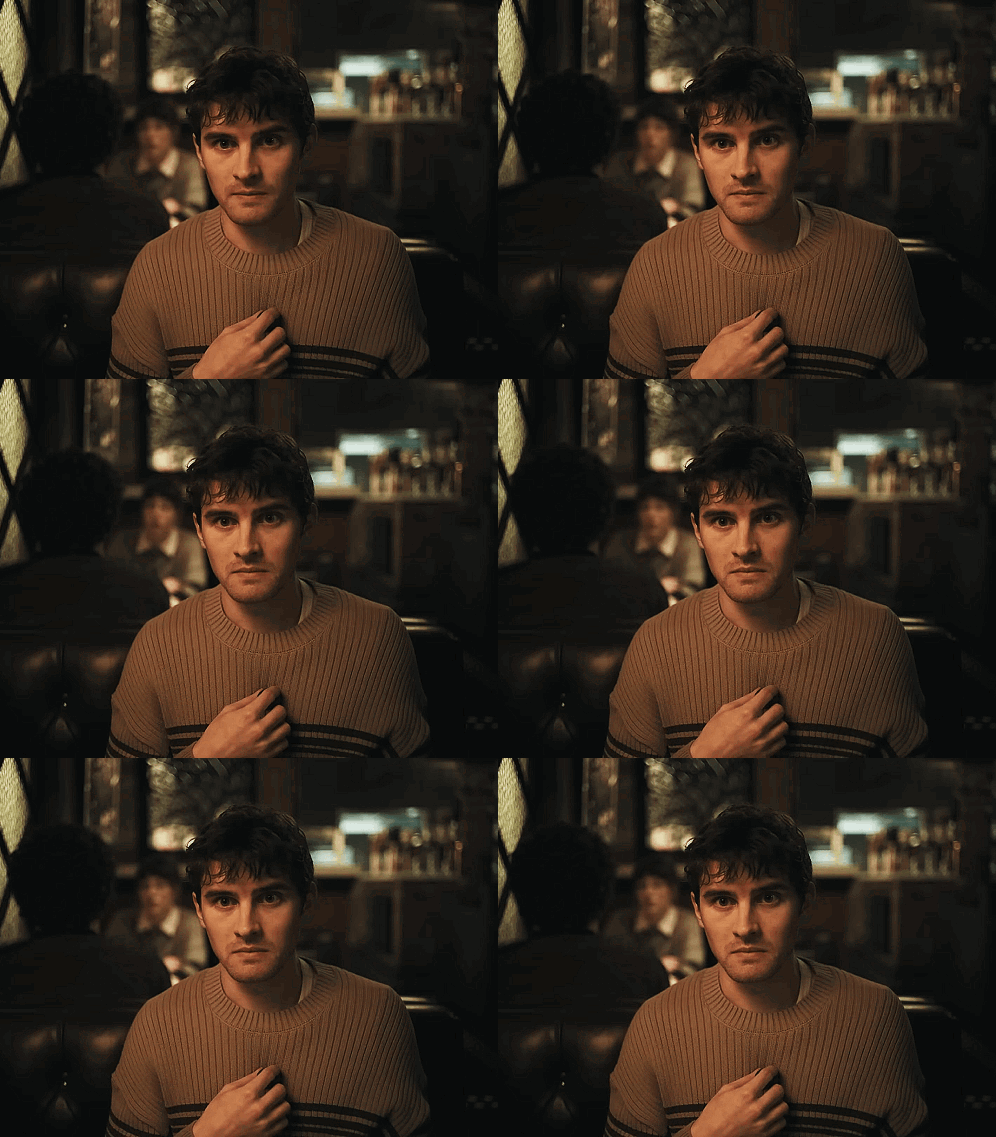
When I asked the Substack gang about this film before I went to see it myself, the word “unsettling” seemed to be the general consensus. Admittedly, I did feel a little apprehensive going into it, as I hadn’t actually watched the trailer (on purpose) so I wasn’t aware of any of the scenes to come. To combat my niggling feeling, I deliberately chose a daytime screening so, if I was really spooked, at least I wouldn’t come out of the cinema into the darkness of the night.
And I have to say, I wholeheartedly agree with that word: unsettling. I was unsettled throughout. Nikki’s love for Bear, in the wake of the wish, is total and all-consuming in a simply terrifying way. How I can best think to describe it is like that really primal feeling there’s a sabre-tooth tiger somewhere, and you just never know quite when it will strike.
Nikki watches Bear sleep. She wants to follow him to the bathroom and wait outside. She stares at him at work and wishes she is on the same shift, because being apart from him even briefly is too much for her. She tapes the front door shut with so much duct tape that Bear has to spend time physically yanking the doorframe almost off to leave the house. That bit, it took my brain a second to process what I was seeing, and then my stomach dropped.
And it kept dropping, again and again. I felt out of control watching this film, which was both a testament to how the story was told, but also the acting itself. Michael Johnston was fantastic in his role: perfectly cast as a boy who never quite found his voice and wants what he can’t have, but if you want a masterclass in acting, you’ve got it here with Inde Navarrette. Wow, wow, wow. She was exceptional, and she just needs to show this film as her audition for anything and everything she wants, because if she can do what she does here, she can do it all. Any director would be lucky to work with her in the future.
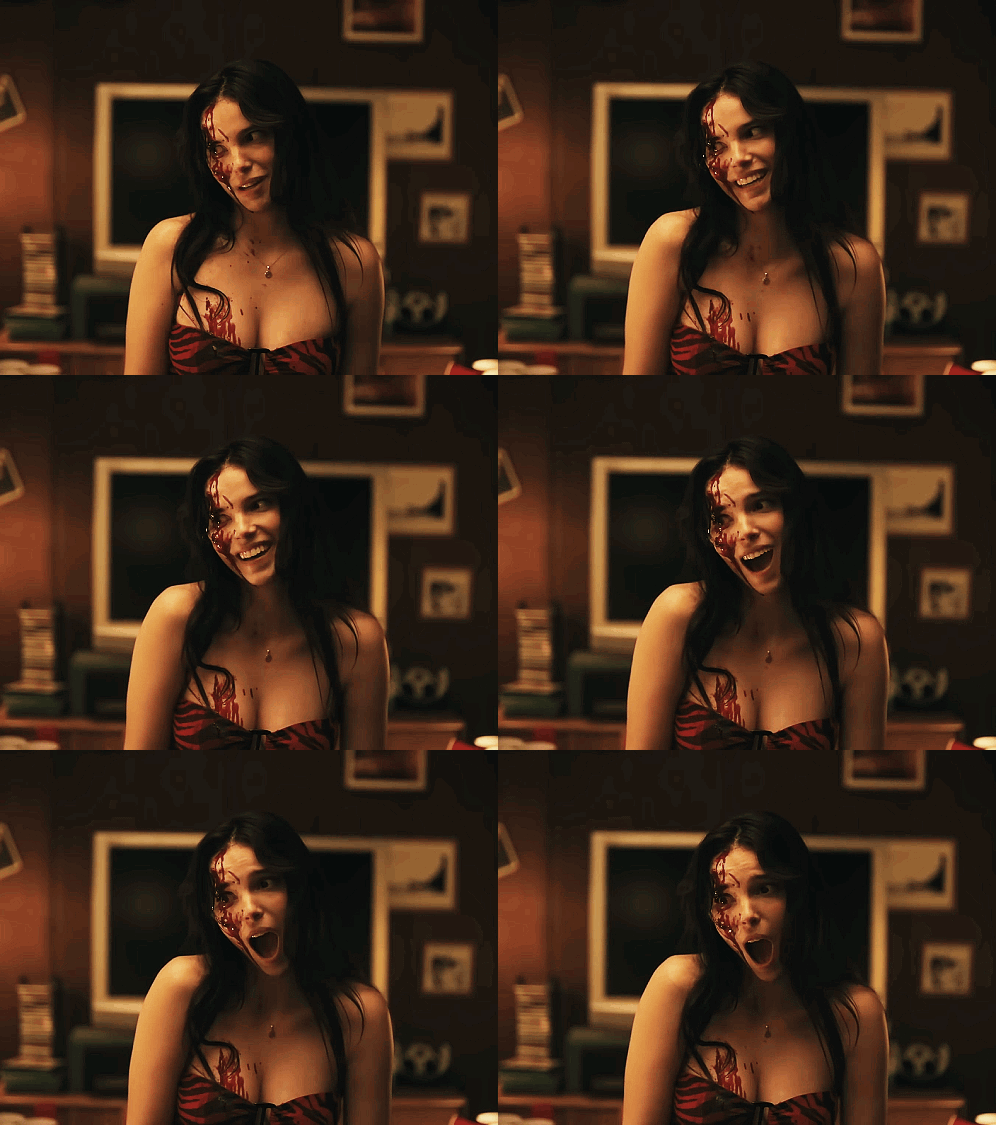
So Nikki’s behaviour starts to look unhinged to her friends, because she went from saying she only liked Bear as a friend to being so all over him that she can’t bear (lol) to be apart from him. She’s lying about serious things like her father being ill, she’s laughing hysterically at strange moments, she’s smashing her own head in with a broken bottle…
And I have to say, her friends don’t really do much at this point. Sarah (Megan Lawless) and Ian (Cooper Tomlinson) are concerned enough to speak to Bear about Nikki’s behaviour, but they then themselves, slightly ironically, don’t talk to Nikki about it. They saw their friend was in trouble, and they buried their heads in the sand.
Then, of course, we have to talk about how Nikki cooks Bear’s dead cat and serves it up in a sandwich for his packed lunch. I also thought I was going to throw up at that moment as the realisation of what was in the sandwich hit me. That scene was so well done.
“You can’t cook the cat.”
There was slight uneasy laughter around the cinema during that line spoken by Bear, because the absurdity of it is not lost on you, so you do laugh, but then you’re actually like, wait, that’s not funny.
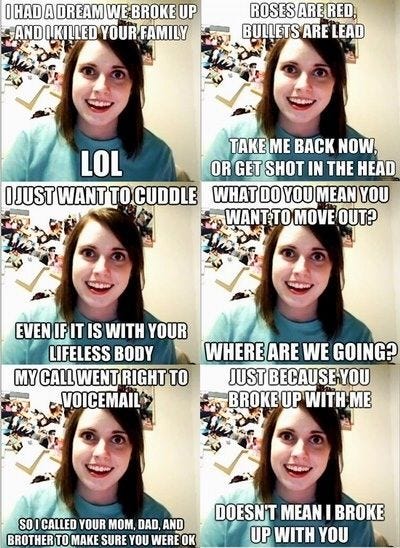
Yet, cast your mind back to 2012 and the Overly Attached Girlfriend meme. Laina Morris’s video spawned a thousand edits, and the joke was a girlfriend who loved her boyfriend a bit too much. It was funny, and we all dined out on that for months. The premise of being loved to the point of obsession was treated as something comedic, something to build content around.
Then, beside the comedy, you’ve got the romanticisation of obsession. You on Netflix, a series entirely about a stalker, became a cultural phenomenon. People were making edits of Joe Goldberg (Penn Badgley), and posting about how they wanted someone to love them the way he loved Beck (Elizabeth Lail).
In fact, strangely enough as I’m writing this, a song comes on my Spotify, Why Don’t You Love Me by Hot Chelle Rae (ft Demi Lovato), with the lyrics:
Why don't you love me?
Touch me
Tell me I'm your everything
The air you breathe
Why don't you love me, baby?
Open up your heart tonight
'Cause I could be all that you need
So what Obsession, as a horror film, does is take those same feelings we sing or laugh about, even desire to some extent, and shows you the actual shape of them.
The film makes watching Nikki’s love for Bear feel impossible to romanticise. You watch a woman losing herself entirely, something done to her without her knowledge or consent, while the man responsible watches it happen knowing it is his fault. There’s a Black Mirror quality to a lot of Obsession, that very specific dread that comes from watching something that feels like a logical and horrible extension of things that already exist. The horror is rooted entirely in feelings and impulses that are human, and it follows them to their darkest possible conclusion.
I wrote recently about how horror has always been at its most effective when it finds the most societally relevant version of fear. Love is one of the most universal human experiences there is. Obsession takes it and asks: what if the thing you wanted most became the thing you should fear most?
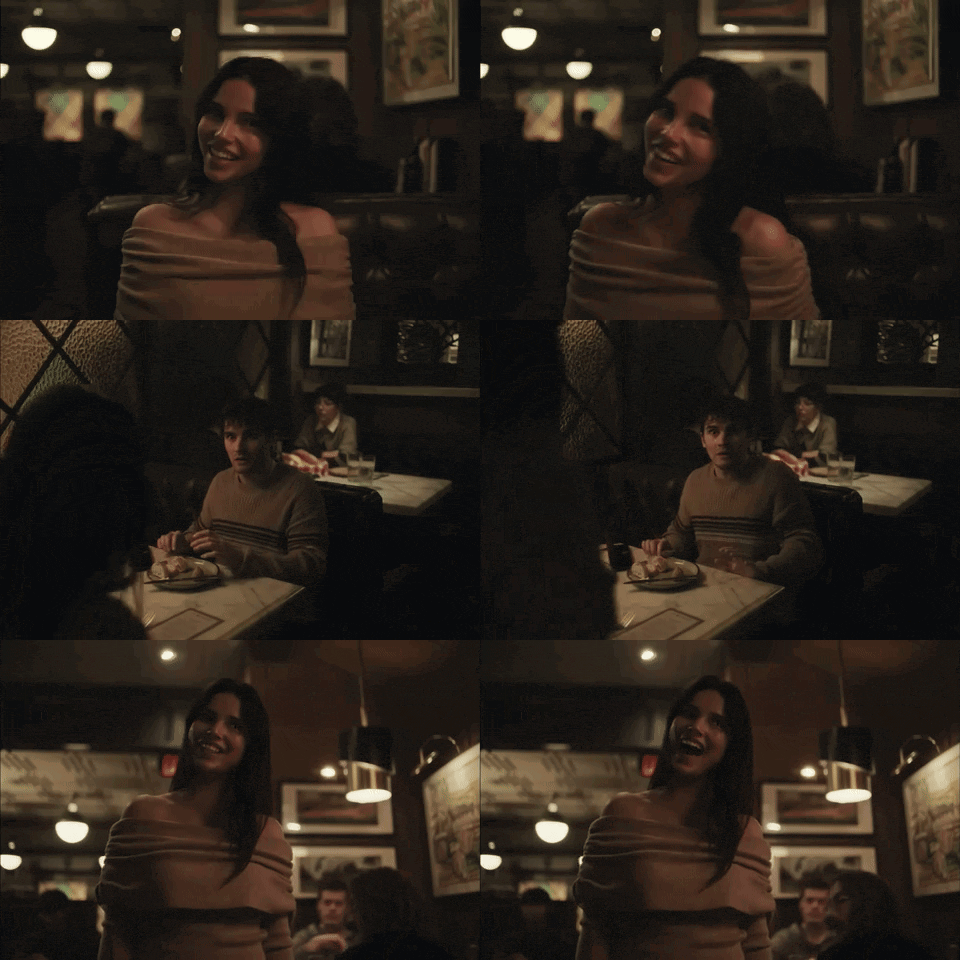
And what Bear wanted, what he specifically asked for was:
“I wish Nikki loved me more than anyone in the fucking world.”
This is where the language of the wish is fascinating, because he wished for the absolute: for her to love him more than anyone in the world, instantly and completely.
If he had said for her to fall in love with him, then maybe he could have shaped things more. Falling in love is a process; it has a pace, a shape, a beginning you can be part of. Bear’s wish skips that stage entirely and drops Nikki straight into the most extreme, uncontrollable version of love imaginable.
But still, even if the language had been different, we couldn’t ever root for it, could we? Because Nikki didn’t consent to that relationship; she didn’t want to be in it.
Bear decided what he wanted, and Nikki paid the consequences of that.
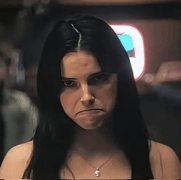
When I was doing some research on this film after I had watched it, I saw the synopsis on IMDb reads: “After breaking the mysterious ‘One Wish Willow’ to win his crush’s heart, a hopeless romantic finds himself getting exactly what he asked for but soon discovers that some desires come at a dark, sinister price.”
I would have to argue that “hopeless romantic” is not the right way to describe Bear. Hopeless romantics have an idealised view of love. They chase the fairy tale, they believe in grand gestures, they see relationships as something beautiful waiting to happen. Bear is not looking for any of that. He is caught up in his own head, and he is, at heart, a coward. Bear has every opportunity to tell Nikki how he feels, but he never takes it. She even asks him outright at one point whether he likes her, and still, he says nothing.
Now, I will say that I’ve actually been there myself, when I’ve been so in love with someone that you are literally afraid of telling them, because of how things could change. But, equally, this is where it becomes more about who Bear is as a person, rather than unrequited love as a concept. Sarah also didn’t tell Bear how she felt either, did she? Yet would Sarah have taken the same route that Bear did?
I would argue no, because what Bear seemed to lack was the emotional regulation to process the feelings he had for Nikki and not let them derail him. We have all been under love’s spell at one point or another, when you look back at moments and think wow I must have really lost my mind there, but, for the most part, we’re able to deal with things and not let our feelings completely ruin someone else’s life.
Because Bear’s love is also fundamentally selfish, and that’s why what happens happens. We see this selfishness through him yelling, “Why can’t you be normal?” and “Is it so bad being with me?” - it’s all about how he feels, and him being frustrated that things haven’t worked out exactly how he wanted them to. It’s like when you’re with a small child, and they spot some funky flavour of ice cream that you know they won’t like but they insist on trying anyway, so they get the tub and, shocker, they don’t like it because it doesn’t taste like chocolate, and so they throw their toys out of the pram.
There is this moment in the musical Waitress, which I also saw this week too and why it was top of my mind:
“Dear baby, I hope someday somebody wants to hold you for 20 minutes straight, and that’s all they do. They don’t pull away. They don’t look at your face. They don’t try to kiss you. All they do is wrap you up in their arms and hold on tight, without an ounce of selfishness to it.”
That is the precise opposite of what Bear does. It was always about him, about his feelings, his desire to be loved, his inability to face vulnerability. He wanted the outcome without the risk.
Nikki’s line, “I’ll be anything you want me to be,” shows how she has no self left. She has been reduced entirely to an extension of Bear’s desire. And there has been a lot of conversation in recent years about people forming emotional attachments to AI, about being in “relationships” with chatbots. A large appeal of that, in my opinion, has to be control. You set the parameters, and you shape it. The chatbot cannot leave you or decide it doesn’t love you back.
Bear wanted a version of that; he wanted the easy way out, essentially. Even if the act of breaking the One Wish Willow was done in rage and frustration, his brain was still willing to let him do it because he thought it was only the way he would get what he wanted. Not what Nikki wanted, right? What he wanted.
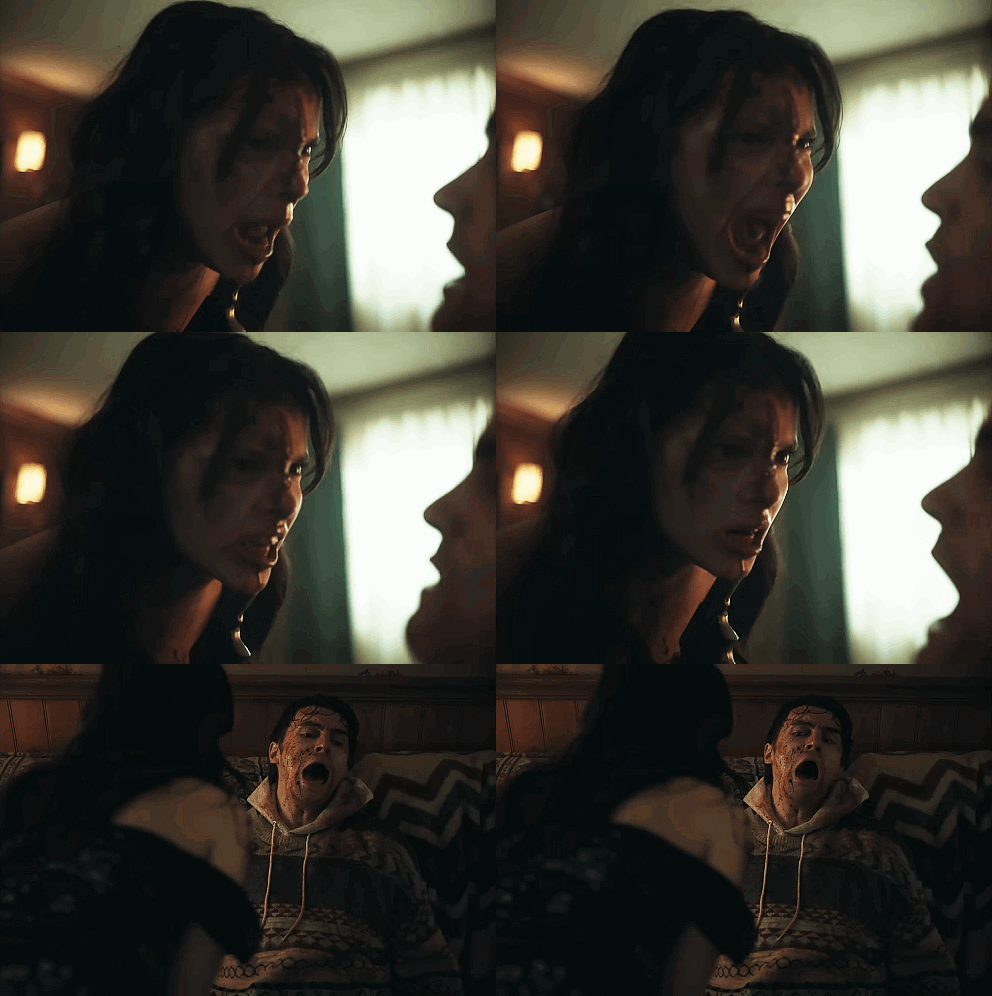
And we see everything culminating in Nikki’s murder of Sarah, which was an incredibly well-played-out scene. When Bear was leaving the house, you had it in your mind that Nikki would follow him, but then just the right amount of time passed between Bear and Sarah in the car that you tipped into a false of security, and when Nikki appeared it completely took me by surprise. I nearly jumped out of my seat, and it was so brutally violent and gore-ish, that it felt like the exact cap to what Bear had released into the world.
So then, we’re left with the question: who should die to break the spell, Bear or Nikki? Which one is “better”? I was torn, because I didn’t think it was fair that Nikki should then lose her whole life, but then could you ever really come back from what she’s done? How can you even begin to process it?
I’m assuming that Nikki used her One Wish Willow to wish for Bear to love her as much as she loves him (due to the reaction when he came back into the living room). And so I began this review by talking about classics, which then comes about again in that there was a Romeo and Juliet esq to the end, where they’d reached the point where they couldn’t live without each other.
Until, once Bear is dead, the wish is broken, and Nikki comes back to herself. She’s sitting there, in an apartment she had never been in, covered in blood, with Bear’s dead body, with Sarah’s corpse in the next room, and what do you do with all that information? It was the perfect ending, because there’s no scooping this back up and tidying it all away. You simply scream and you scream and you scream and you scream.
Before you go… in my paid subscription tier, I do a sort of Media Studies class style approach for some of my pieces, and so I leave people with a few questions to think about.
I thought it would be fun to do the same for Obsession here, as it really does leave you with a gazillion questions to consider.
The One Wish Wonder man on the phone says something similar to: “Just because you chose it for her, doesn’t make it not real.” Do you think this is the most unsettling part? That something you didn’t choose can become your reality, and there’s nothing you can do about it. Perhaps particularly so in 2026, due to the increase in artificial technology and companies that are so ingrained in our daily lives
Bear seemed to again, get the easy way out, because he died and didn’t have to experience the losing control of being under Nikki’s wish. He left Nikki to deal with the consequences of his choices. Is that the film’s final word on who pays the price when someone takes what they want without asking?
And finally, if Nikki’s wish had pulled Bear into the same total, consuming love that Nikki experienced, would equal obsession have been carnage, or something closer to a dark equilibrium?
My favorite horror movie of the year 😁
Wonderful review. It made me like the movie that much more with your insights.